
TOKYO HIGH DENTAL CLINIC
Protrusion Correction
In brief
Non-extraction protrusion correction moves the dentition backward into the wisdom-tooth space using an orthodontic screw.
Orthodontic care at Tokyo High Dental is handled from the first consultation to the end of treatment by Dr. Ahn Jin-gyu, who completed formal orthodontic training and a doctoral course at Tokyo Medical and Dental University. Treatment is planned after reviewing skeletal, dental and facial balance on a 3D high-resolution CT (VATECH).
Accurate diagnosis, the best solution
Non-extraction protrusion correction controls the delicate movement of the teeth.
By predicting tooth movement and angle changes and attaching carefully selected specialized appliances at the right places based on each tooth’s center-of-gravity point,
the margin of error is minimized to achieve the best result.
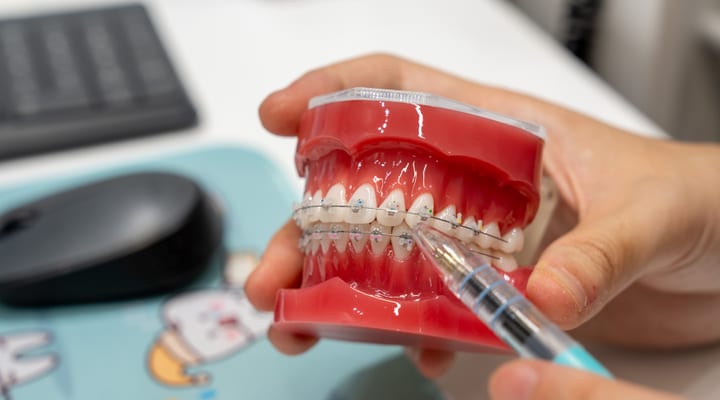
The principle of non-extraction protrusion correction
A spring or elastic is connected between the braces and an orthodontic screw (Screw) to move the dentition backward.
Because it uses the empty space created by extracting the wisdom teeth, it reduces the burden of extracting natural teeth while improving the protrusion.
However, if the protrusion of the teeth and gums is severe, extraction may be necessary.
Treatment process
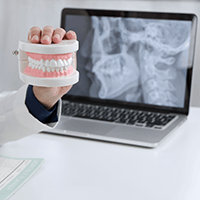 PROCESS·01
We perform 3D analysis and a detailed examination to determine whether it is a case in which the protrusion can be improved without extraction.
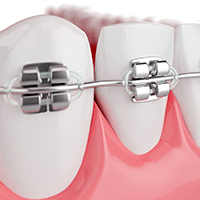 PROCESS·02
Using an orthodontic screw (Screw), the entire dentition is moved backward into the wisdom-tooth space.
 PROCESS·03
As the whole dentition is pushed inward, the protrusion recedes and the dentition and mouth line become tidy.
We recommend this for the following

Cases where the mouth still looks protruded even after completing extraction orthodontics
Cases where the protrusion is not severe and you want to improve it without extracting teeth if possible
Cases of protrusion with wide gaps between the teeth
Cases where you feel burdened by extracting permanent teeth
Cases where you want mouth-line correction without extracting teeth
Frequently Asked Questions
How long does orthodontic treatment take?
Full orthodontic treatment usually takes about one and a half to two years, and partial orthodontics often finishes within six months to a year.
Is orthodontic treatment very painful?
There is soreness or discomfort for the first few days, but you gradually get used to it. Painkillers can be prescribed if needed.
Are there food restrictions during orthodontic treatment?
Hard or sticky food (taffy, caramel, etc.) can damage the appliance, so it is best to avoid them.
This treatment information was reviewed by our dental team on 2026-07-29.